How to Unblock Your Ears After a Flight
You can unblock your ears after a flight by making your eustachian tube open and let air in. Yawning, swallowing, chewing gum, and two gentle breathing techniques do this for most people within minutes to hours.
This guide ranks every fix from gentlest to strongest and tells you when to stop and call a doctor.
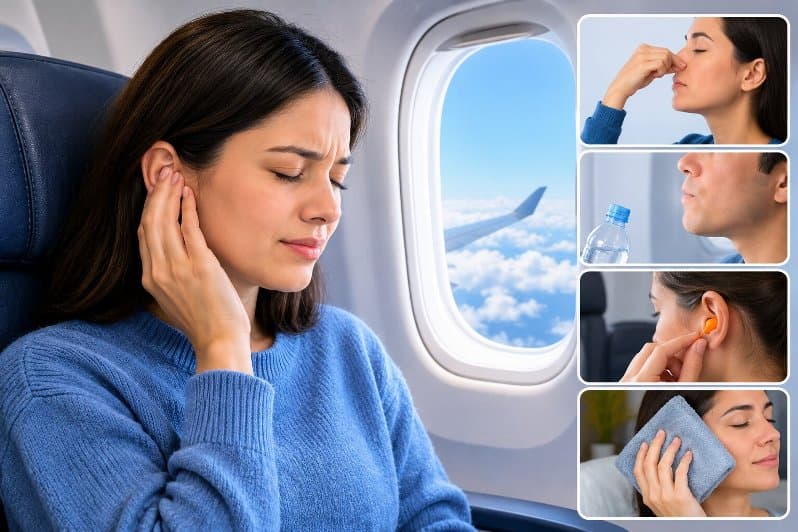
Table of Contents
What Causes Blocked Ears After a Flight?
Your ears block after a flight because the air pressure in your middle ear no longer matches the air pressure around you. Doctors call this airplane ear, or ear barotrauma. It is also named barotitis media or aerotitis media.
The middle ear is the air filled space behind your eardrum. A narrow channel called the eustachian tube connects it to the back of your nose and throat. During climb and descent, the tube often cannot adjust fast enough, and that delay causes the symptoms.
Think of a sealed bag of chips on a mountain drive. The bag puffs up because the air inside is at a different pressure than the air outside. Your middle ear is the bag, and the eustachian tube is the small valve that has to open to even things out.
What Are the Symptoms of Airplane Ear and Which Ones Are Serious?
Most airplane ear is mild and shows up as a stuffed, full feeling with muffled sound. It can affect one ear or both.
Severe symptoms mean you should get medical care instead of relying on home fixes.
| Level | Symptoms |
|---|---|
| Mild to moderate | Ear discomfort or mild pain, a feeling of stuffiness or fullness, muffled hearing or mild hearing loss |
| Severe | Severe pain, a sharp rise in ear pressure, moderate to severe hearing loss, ringing in the ear (tinnitus), a spinning feeling (vertigo), bleeding from the ear |
How to Unblock Your Ears After a Flight
Work through these six steps in order, because each one is stronger than the one before it.
Stop as soon as your ears clear. If a step makes the pain worse, stop and skip ahead to the doctor section below.
Step 1: Yawn, Swallow, or Chew Gum
Yawning, swallowing, and chewing gum are the first things to try, because these movements open the eustachian tube and usually even out the pressure. They carry no risk and cost nothing.
Chew a piece of gum or sip water and swallow repeatedly for a few minutes. Do not stop after one try. The tube may need several openings before the pressure settles.
Step 2: Try the Valsalva Maneuver Gently
The Valsalva maneuver pushes air through the eustachian tube from the back of your nose.
Pinch your nostrils shut, close your mouth, and blow out gently, as if you were inflating a small balloon. You should feel or hear a pop in your ears.
Blow gently. Hard blowing can strain the eardrum and does not help more. If nothing happens after two or three soft attempts, move on to the next step.
Step 3: Try the Toynbee Maneuver
The Toynbee maneuver uses swallowing instead of blowing, so it puts less pressure on the ear.
Pinch your nostrils shut, take a small sip of water, and swallow with your nose still pinched.
Repeat a few times. Many people find this easier than the Valsalva maneuver because there is no forceful blowing involved.
Step 4: Use a Decongestant If Self Care Fails
A decongestant shrinks swollen tissue around the eustachian tube, which lets air pass. Decongestant nasal sprays and decongestants taken by mouth as medicines that may help when symptoms do not clear.
Use a nasal spray for only a few days. Longer use can cause rebound congestion, which is worse stuffiness once the medicine wears off.
Ask a pharmacist before taking decongestant tablets if you have high blood pressure, a heart condition, or you take other medicines.
Step 5: Ease the Ache With Acetaminophen
If your ear hurts while it recovers, acetaminophen (Tylenol and other brands) is the pain reliever suggests for airplane ear. Follow the dose on the label.
Pain relief does not unblock the ear. It only makes the wait easier, so keep using Steps 1 to 3 as well.
Step 6: Give It Time
For most people, airplane ear heals with time. Even severe injuries, such as a burst eardrum or torn inner ear membranes, usually heal on their own.
Repeat the gentle steps every so often during the first day or two. If the blocked feeling is still there after a few days, read the next sections.
Check This: Home Remedies for Relieve TMJ Ear Pain
Which Mistakes Make Blocked Ears Worse?
The most common mistake is poking something into the ear canal. Cotton swabs, hairpins, and fingers can break the thin skin lining the canal and lead to infection. They also cannot reach the middle ear, where the pressure problem sits.
Three other habits slow recovery:
- Blowing hard during the Valsalva maneuver, which strains the eardrum instead of opening the tube.
- Using a decongestant nasal spray for more than a few days, which can bring back worse congestion.
- Sleeping through descent on your next flight, since you swallow less when asleep.
When Should You See a Doctor for Blocked Ears After Flying?
See a doctor if discomfort, fullness, or muffled hearing lasts more than a few days, or if you have any severe symptom.
Severe symptoms are intense pain, bleeding from the ear, strong hearing loss, ringing, or a spinning sensation.
A doctor can usually diagnose airplane ear from your history and an ear exam with a lighted tool called an otoscope.
You may be referred to an ear, nose, and throat (ENT) specialist if self care does not work. Surgery is rarely needed, and when it is, it is often a small office procedure.
How Do You Unblock a Child’s or Baby’s Ears After a Flight?
Babies and young children cannot do the Valsalva maneuver on command, so the goal is to get them swallowing.
A bottle, a breast feed, a pacifier, or sips from a cup all make a child swallow, and swallowing opens the eustachian tube.
For older children, chewing and sipping drinks work the same way as for adults. Check with a doctor or pharmacist before giving a young child any decongestant or pain reliever, because dosing depends on age and weight.
Take a child to a doctor if they keep pulling at an ear, cry when swallowing, or seem to hear poorly after a few days.
How Can You Prevent Blocked Ears on Your Next Flight?
Prevention works best when you act before takeoff and again before landing. An over the counter nasal spray or a decongestant tablet 30 to 60 minutes before takeoff, with a second spray about 30 minutes before landing.
| When | What to do |
|---|---|
| Before takeoff | Use a decongestant spray or tablet 30 to 60 minutes ahead, if it is safe for you |
| During climb | Chew gum, swallow often, and stay awake |
| 30 minutes before landing | Use the spray again, then yawn and swallow throughout descent |
| After landing | Try the Toynbee or gentle Valsalva maneuver if your ears are still full |
People with a cold, sinusitis, allergies, or a middle ear infection are more likely to get painful airplane ear because their tubes are already swollen. Talk to a doctor before flying if you are very congested.
Conclusion
Airplane ear is common and temporary, and you have the most control over it before it starts.
The pressure change happens during climb and descent, so that is when your habits count.
Pack gum, decide ahead of time whether a decongestant is safe for you, and stay awake as the plane comes down.
If your ears block on most flights, tell a doctor before your next trip.
Allergies or a lingering cold can keep the eustachian tube swollen, and treating that is easier than treating the ear after you land.