Why Does My Elbow Hurt When I Extend It? Causes and Relief
Elbow pain when you extend (straighten) your arm comes from six common problems: tennis elbow, triceps tendinitis, posterior impingement, olecranon bursitis, arthritis, and loose bodies inside the joint. The location and feel of the pain tell you which one is most likely.
Two terms help here. A tendon is the tough cord that attaches a muscle to a bone. A bursa is a small, fluid filled sac that cushions the space between a bone and the skin or tendon above it.
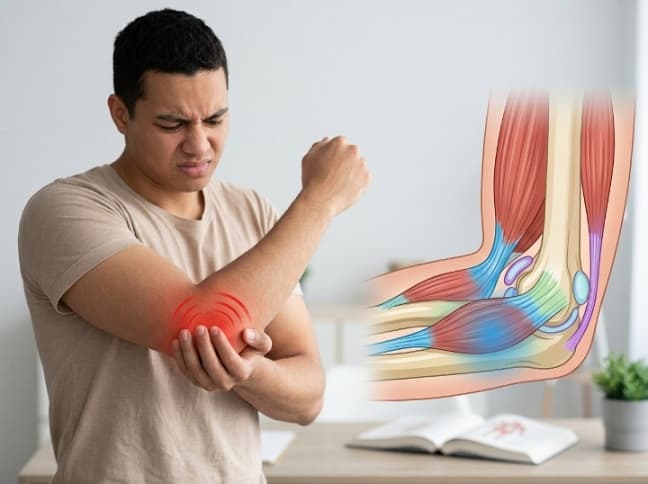
The table below matches the pain pattern to the likely cause. Each cause has its own section after it.
| Where and how it hurts | Likely cause |
|---|---|
| Outer elbow, worse with gripping or lifting | Tennis elbow |
| Back of the elbow, worse when pushing | Triceps tendinitis |
| Back of the elbow, only at the last few degrees of straightening | Posterior impingement |
| Swelling at the bony tip of the elbow | Olecranon bursitis |
| Stiffness, grating, or a slow loss of full straightening | Elbow arthritis |
| Sudden catching or locking during movement | Loose bodies |
Table of Contents
Pain on the Outer Elbow: Tennis Elbow
Tennis elbow (lateral epicondylitis) is an overuse injury of the forearm tendons that attach to the bony bump on the outer elbow.
Pain on the outside of the elbow that rises with gripping, lifting, or carrying with a straight arm points to it.
The affected muscles are the ones that straighten and raise the wrist. Small tears can form in the tendon where it attaches to the bone. The pain gets worse when you lift a heavy object, make a fist, shake hands, or turn a door handle.
You do not need to play tennis to get it. Gardening and painting can also cause it, and some people find it hard to fully bend or straighten the elbow because of the pain.
The first step is to stop the activities that cause or worsen the pain. Activity changes should continue for at least six weeks.
Tennis elbow often resolves on its own, given time. Ice packs and a forearm brace can ease symptoms in the meantime.
Pain at the Back of the Elbow: Triceps Tendinitis
Triceps Tendinitis is irritation of the tendon that connects the triceps muscle to the tip of the elbow.
It causes pain at the back of the elbow that gets worse when you straighten the arm against resistance, such as pushing yourself up from a chair.
Think of the tendon as a rope fraying at the point where it is anchored. Repeated pushing, weightlifting, throwing, or a sudden jump in activity can wear it down. Symptoms include tenderness over the tip of the elbow, mild swelling, and weakness when pushing or lifting.
A fall or sudden impact can also injure this tendon. Pain in these cases is felt at rest as well as during exercise, and the spot just above the bony point at the back of the elbow is tender to touch.
Continued strain can weaken the tendon and, in severe cases, tear it partly. A pop or sudden weakness while pushing is a reason to get the elbow examined.
Pain at the End of Straightening: Posterior Elbow Impingement
Posterior elbow impingement is pain at the back of the elbow that appears when the arm reaches its maximum straightening point. It is a common cause of pain at the back of the elbow.
Picture a door swinging shut until it meets the stopper. At full extension, the bony tip of the elbow swings into a hollow at the back of the upper arm bone. If swollen tissue or extra bone sits in that gap, it gets pinched.
The pattern is the clue. Triceps tendinitis hurts when you push against resistance. Impingement hurts at the very end of the range, even with no load on the arm.
Swelling at the Tip of the Elbow: Olecranon Bursitis
Olecranon Bursitis is swelling of the bursa at the bony tip of the elbow. Swelling is often the first sign.
Pain follows as the sac stretches, and it usually worsens with direct pressure or with bending the elbow.
Large swelling can restrict elbow motion. The skin on the back of the elbow is loose, so a small amount of swelling may go unnoticed at first.
Common causes include a hard blow to the elbow and long periods of leaning on it, for example on a tabletop or a car armrest. Long plank holds can also bring it on. Rheumatoid arthritis and gout are linked to it as well.
An infected bursa is different. The skin turns red and warm, and untreated infection can spread to other parts of the arm or into the bloodstream. Red, warm skin over a swollen elbow needs a doctor the same day.
For a bursa that is not infected, using elbow pads, avoiding pressure on the swollen elbow, and nonsteroidal anti inflammatory drugs (NSAIDs) such as ibuprofen.
If pain and swelling do not respond after 3 to 6 weeks, a doctor may remove fluid and inject a corticosteroid, though some patients get no relief from the injection.
Stiffness and Grating: Elbow Arthritis
Elbow Arthritis is wear or damage to the joint cartilage. Its two most common symptoms are pain and loss of range of motion, and they may not appear at the same time.
Cartilage is the smooth coating on the ends of the bones. When it wears away, movement feels rough.
Patients often describe a grating sensation. Swelling usually appears later, as the condition progresses.
Pain from osteoarthritis may get worse as you extend the arm. Pain at night or at rest suggests a more advanced stage.
Rheumatoid arthritis is more likely to cause swelling and pain in both elbows.
The elbow is one of the joints least affected by osteoarthritis, because its joint surfaces fit well and its ligaments are strong.
Old injuries change that. A ligament injury that leaves the elbow unstable can wear the joint faster, even when the joint surface was not damaged.
In later stages, numbness in the ring and little fingers can appear. The ulnar nerve (the “funny bone” nerve) runs through a tunnel on the inner side of the elbow, and joint swelling or limited motion can raise pressure on it.
Catching or Locking: Loose Bodies in the Joint
Loose bodies are small pieces of cartilage or bone that break off inside the elbow. A sudden catch or lock that blocks straightening is the typical sign, and it needs a medical exam.
Locking happens when these pieces become trapped between the moving joint surfaces and block motion. They are often a byproduct of cartilage damage or arthritis, so locking and grating tend to show up together.
A locked elbow that will not move is different from a stiff elbow that loosens with warm up. If your elbow locks, avoid forcing it and book an appointment.
What to Do at Home for Mild Elbow Pain
For mild pain with no injury behind it, reduce the activity that hurts, protect the elbow, and give it several weeks. That plan matches the guidance for tennis elbow and for a noninfected bursa.
- Stop or reduce the movements that bring on the pain, such as repeated gripping, heavy pushing, or leaning on the elbow.
- Use an elbow pad if pressure on the tip of the elbow is the problem.
- Apply ice packs for short periods to ease pain.
- Ask a pharmacist or doctor whether an NSAID is safe for you before taking one.
Track the elbow for 3 to 6 weeks. That is the window after which the AAOS suggests further treatment for bursitis, and the minimum trial of activity changes for tennis elbow.
When to See a Doctor About Elbow Pain
See a doctor promptly if the pain follows a fall or direct blow, if the elbow is red, warm, and swollen, or if it locks. A fall onto a bent elbow can fracture the bony tip.
Also book a visit if you notice numbness in the ring or little finger, a pop with sudden weakness, or pain that does not improve after 3 to 6 weeks of home care.
This article is general information, not a diagnosis. A doctor can examine the elbow and order imaging if needed. X rays, for example, can show a bone spur at the tip of the elbow.
Conclusion
Elbow pain when you extend the arm has a short list of common causes, and the location of the pain narrows it down fast.
Outer elbow pain points to tennis elbow, back of the elbow pain to the triceps tendon or impingement, swelling at the tip to bursitis, and grating or locking to the joint itself.
Most overuse problems settle with several weeks of activity changes. Pain after a fall, a red and warm elbow, a locked joint, or numb fingers should not wait.
If the pain has lasted 3 to 6 weeks without improving, book an exam so the cause can be confirmed.