What Not to Eat With a Sinus Infection for Faster Relief
Skip alcohol first. Then cut back on added sugar, and drop any high histamine food that clearly makes your nose more blocked.
You do not need to give up dairy unless you have a milk allergy, because the evidence does not support the old belief that milk makes mucus.
A sinus infection (also called sinusitis) happens when fluid builds up in the air filled pockets of your face and germs grow in it. Viruses cause most cases, and bacteria cause some.
Diet will not clear the infection. It can only make you more or less comfortable while your immune system does the work. The table below shows how strong the case is for each food group.
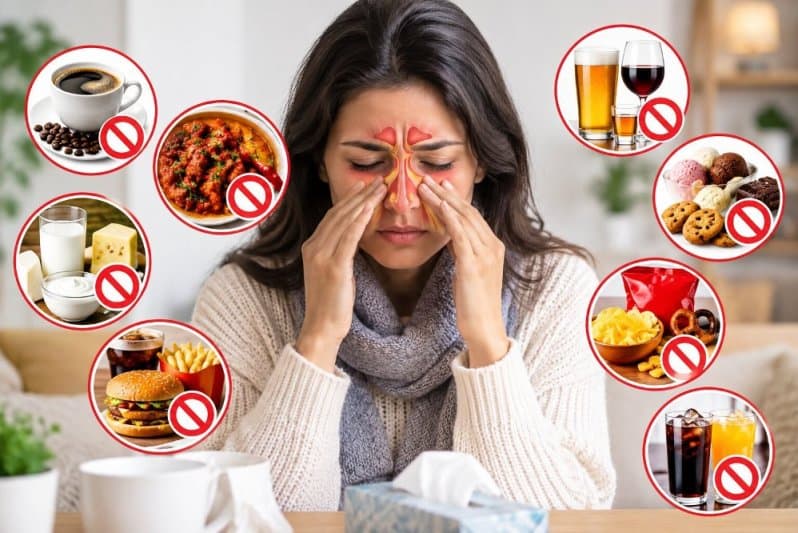
| Food or drink | How strong is the case? | Who should skip it |
|---|---|---|
| Alcohol | Based on known effects on blood vessels, histamine, and hydration | Anyone with a sinus infection |
| Refined sugar (soda, candy, baked goods) | Limited evidence, mostly in children | Anyone who notices more congestion after sweets |
| High histamine foods (aged cheese, cured meats, chocolate) | Limited evidence, mainly for histamine intolerance | People who react to these foods |
| Salicylate rich foods | Studies focus on chronic sinus problems | People with nasal polyps or known sensitivity |
| Dairy | Mixed evidence, no proof of extra mucus | People with a milk allergy |
Table of Contents
Why is Alcohol the Best Supported Drink to Skip?
Alcohol can make a stuffy nose worse because it causes blood vessels to widen and narrow, which swells the nasal passage.
It also dehydrates you and adds histamine, a chemical your immune system releases that causes inflammation and allergy symptoms.
Think of your sinuses as a sink drain. Thin mucus flows out, and thick mucus clogs the pipe. Water keeps mucus thin, and alcohol works against that.
Some drinks carry more histamine than others. Beer, red wine, champagne, port, sherry, and some liqueurs are high in it, and even nonalcoholic beer and wine contain histamines.
Alcohol can also reduce production of diamine oxidase (DAO), an enzyme that breaks down extra histamine. Lower DAO means histamine builds up, and congestion follows.
Does Dairy Make a Sinus Infection Worse?
For most people, no. The belief that milk creates mucus is old, but the best known test found no connection.
Researchers infected 60 volunteers with a cold virus and tracked symptoms for 10 days. Milk and dairy intake was not linked to congestion or to the weight of nasal secretions.
The same study found something odd. People who believed milk makes mucus reported more cough and congestion, yet they did not produce more nasal secretions.
The picture is not completely settled. A double blind trial of 108 people compared cow’s milk with soy milk for 4 days. The soy group had a larger drop in nasal mucus, and the authors called the milk and mucus theory plausible but in need of more research.
Milk allergy is a separate case. Allergic reactions to milk have been linked to more nasal polyps and to a higher rate of chronic sinusitis. If you have a milk allergy, avoid dairy. If you do not, there is probably no need to remove it.
Do Sugary Foods Make a Sinus Infection Worse?
They might. Refined sugar, the kind in soda, candy, and baked goods, may increase inflammation and worsen sinus symptoms. The fruit sugar in whole fruit is not the concern.
Some evidence shows that high sugar diets worsen sinus symptoms in children, and that cutting added sugar improved symptoms and quality of life in that group. Some providers also advise adults to avoid refined sugar, but research is limited.
The practical takeaway is low risk. Skipping sweets for a week or two while you recover costs you little, and you can see whether your congestion eases.
Which High Histamine Foods Can Make Congestion Worse?
High histamine foods matter mostly if your body clears histamine slowly, a condition called histamine intolerance.
In healthy people, histamine from food is broken down quickly. In people with intolerance, it builds up and can cause sneezing, a blocked nose, and a runny nose.
Foods high in histamine include:
- Processed meats such as sausage, salami, and ham
- Dried or preserved fish and fish sauces
- Tomatoes, avocado, and eggplant
- Dried fruit such as raisins and apricots
- Aged cheeses and chocolate
- Fermented foods such as sauerkraut, kimchi, yogurt, and vinegar
- Fermented drinks such as kombucha and alcohol
Several of these foods are otherwise healthy, so do not drop them all at once. Pay attention instead. If one food reliably leaves you more blocked within a few hours, skip it until you recover.
Do You Need to Avoid Salicylate Rich Foods With a Sinus Infection?
Probably not for a short infection. Salicylates are natural compounds in foods such as berries, watermelon, beans, oats, and spices like paprika and turmeric. Some people are sensitive to them, and the reaction can include nasal congestion and nasal polyps.
The studies on this topic looked at chronic sinus problems. One cross sectional study linked high salicylate intake to worse symptoms in people with chronic sinusitis and nasal polyps, though an observational study cannot prove cause and effect. A double blind crossover study saw improvement after 6 weeks on a salicylate free diet.
That diet is hard to follow. Talk to a healthcare provider before trying it.
What Should You Eat and Drink Instead?
Drink plenty of fluids. Water, broth, and warm tea all work.
Fluids pair well with other comfort steps:
- Put a warm compress over your nose and forehead to ease sinus pressure.
- Use a saline nasal spray or a decongestant.
- Breathe in steam from a bowl of hot water or a shower.
- Run a clean humidifier to moisten the air at home.
Eating well is still worth the effort. A balanced meal supports your body while it fights the infection, even though no single food speeds recovery.
When Should You See a Doctor?
See a healthcare provider if your symptoms last more than 10 days without improving. Most sinus infections get better on their own, so waiting a few days is normal. Certain signs mean it is time to call:
- Severe headache or facial pain
- Symptoms that get worse after starting to improve
- Fever lasting longer than 3 to 4 days
- Multiple sinus infections in the past year
Go to the emergency room for a fever over 103 degrees Fahrenheit (40 degrees Celsius), confusion, vision changes, seizures, or a stiff neck. These are rare signs that the infection may have spread beyond the sinuses.
Conclusion
Alcohol is the one drink with a clear reason to skip while you have a sinus infection.
Added sugar and high histamine foods are worth cutting back on if your congestion gets worse after eating them, and dairy stays on the menu unless you have a milk allergy.
Food will not shorten the infection. Fluids, saline spray, and rest are what help most, and most people feel better within a week to 10 days. If you are still sick after 10 days, book a visit with your doctor.