Why Does My Knee Click When I Bend It?
You squat down to grab something. Click. You stand up from the couch. Pop. Noisy knees can sound alarming, especially if they seem to get louder over time.
But here is the reassuring part. In most people, a clicking knee with no pain is completely normal. Doctors even have a name for joint noise.
They call it crepitus. The question that matters is not whether your knee makes noise. It is whether the noise comes with pain or other problems.
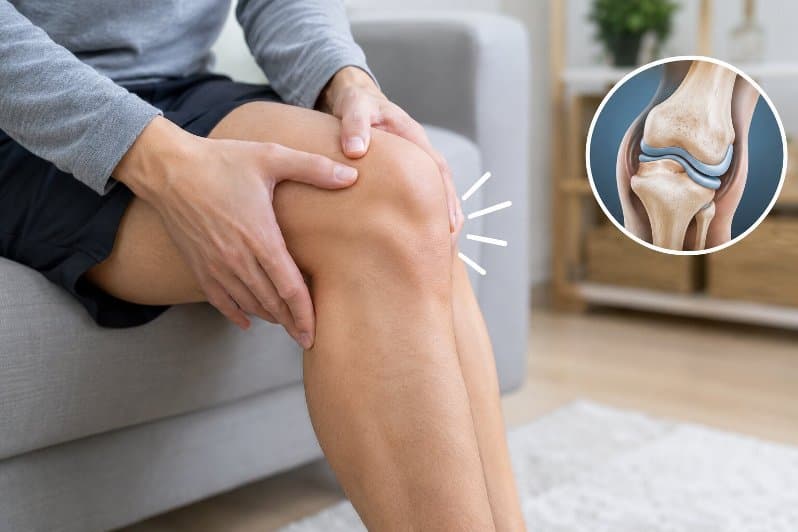
Most knee clicking comes from tiny gas bubbles in the joint fluid, or from tendons and ligaments sliding over bone. Cleveland Clinic describes joint popping as a normal, common occurrence.
Clicking becomes a concern when it comes with pain, swelling, locking, catching or a knee that gives way.
Normal Click or Warning Sign?
| Usually normal | Worth getting checked |
|---|---|
| No pain at all | Pain with the click |
| No swelling | Swelling, warmth or redness |
| Full, easy movement | Knee locks, catches or gets stuck |
| Happens now and then | Knee feels unstable or gives way |
| Started gradually, no injury | Started after a twist, fall or pop during sport |
| Click feels like knuckles cracking | Grinding that gets worse over months |
Harmless Causes of Knee Clicking
1. Gas bubbles in the joint
Your knee sits in a capsule filled with fluid. That fluid holds dissolved gases. When you bend your knee, the pressure inside changes. A small bubble forms or bursts, and you hear a pop.
It is the same thing that happens when you crack your knuckles. Houston Methodist calls this completely harmless.
2. Tendons and ligaments snapping over bone
As you bend, tendons and ligaments glide over the bumps of your knee bones. Sometimes they shift slightly and snap back into place.
This makes a click or a soft snap. It is common, painless and nothing to fear.
Causes That May Need Attention
3. Runner’s knee (patellofemoral pain syndrome)
This causes pain around or behind the kneecap. It often affects runners, young adults and people who suddenly increase activity. According to OrthoInfo, symptoms can include popping or crackling sounds when climbing stairs or standing up after sitting a long time.
Weak thigh and hip muscles can make the kneecap track poorly. Our guide to knee pain when bending covers this in detail.
4. Knee osteoarthritis
Over time, the smooth cartilage in the knee can wear down. The surfaces then rub less smoothly and may grind or crackle. Arthritis noise usually comes with stiffness, aching and pain that is worse after activity.
5. A meniscus tear
The meniscus is a rubbery cushion between your thigh bone and shin bone. A sudden twist can tear it, and it also wears with age.
A torn piece can catch in the joint. That causes clicking along with pain, swelling, or a knee that locks. Support can help while it heals. See our picks for the best knee brace for a meniscus tear.
6. Plica or IT band irritation
A plica is a fold in the joint lining. If it gets irritated, it can snap over the bone as you bend.
The IT band on the outside of the thigh can also rub and snap near the knee. Both are more common in active people.
If outer knee pain keeps you up, read how to sleep with IT band pain.
7. An old injury or surgery
Scar tissue and small changes after an injury or knee surgery can make the joint noisier. This is often harmless, but new pain should be checked.
Simple Ways to Quiet and Protect Your Knees
Strong muscles help your kneecap glide smoothly. Try these gentle moves. Stop any exercise that causes sharp pain.
| Exercise | How to do it | Muscles it helps |
|---|---|---|
| Straight leg raise | Lie on your back, tighten your thigh, lift a straight leg about 30 cm, lower slowly. 10 times each side. | Quadriceps (front of thigh) |
| Glute bridge | Lie on your back with knees bent, lift your hips, hold 3 seconds, lower. 10 times. | Glutes and hamstrings |
| Clamshell | Lie on your side with knees bent, lift your top knee while keeping feet together. 10 times each side. | Outer hip muscles |
| Mini squat | Hold a chair, bend your knees slightly, keep them over your toes, stand back up. 10 times. | Quadriceps and glutes |
| Hamstring stretch | Sit with one leg straight, reach gently toward your toes, hold 20 to 30 seconds. | Back of thigh |
A few habits help too:
- Warm up for five minutes before exercise.
- Choose low impact cardio like cycling, swimming or walking.
- Increase running or training slowly instead of all at once.
- Keep a healthy weight to cut the load on your knees.
- Wear supportive shoes that suit your activity.
When to See a Doctor
Make an appointment if your clicking knee comes with:
- Pain that lasts more than a few days or keeps coming back
- Swelling, warmth or redness
- Locking, catching or trouble fully bending or straightening
- A feeling that the knee gives way
- A loud pop at the moment of an injury
- Burning, tingling or shooting pain.
Get urgent care if you cannot put weight on the leg or the knee looks deformed after an injury.
FAQ
Is it bad if my knee clicks but does not hurt?
Usually not. Painless clicking is very common and is often caused by gas bubbles or tendons moving. If there is no pain, swelling or locking, it is generally not a concern.
Why do my knees click when I squat?
Squatting changes the pressure in the joint and moves the kneecap through its groove. This can release gas bubbles or make tendons snap. If squatting also hurts the front of your knee, runner’s knee is a common cause.
Can young people have clicking knees?
Yes. Knee noise is common at every age. In young active people, it is often harmless or linked to runner’s knee.
Does clicking mean I have arthritis?
Not on its own. Arthritis noise tends to be a grinding feel with stiffness and pain. A click with no other symptoms is rarely arthritis.
Can exercise stop my knee from clicking?
It may reduce it. Stronger thigh and hip muscles help the kneecap track better. Even if the click stays, stronger muscles protect the joint.
Should I wear a knee brace for a clicking knee?
A brace is not needed for a painless click. It may help if you have pain from a specific problem like a meniscus tear. Ask your doctor which type suits you.
This article is for general information only. It is not a substitute for advice from your own doctor or physical therapist.