Why Do I Feel Drained After an MRI Without Contrast?
Table of Contents
Key Takeaways
- Post-MRI fatigue without contrast is caused by noise stress, forced immobility, anxiety, and possible dehydration – not by any substance in your body.
- The scan’s magnetic field and thermal effects are within safe limits but still place a real load on the nervous system, especially during long protocols.
- Recovery is fastest with food, water, and 1-2 hours of low activity immediately after the scan.
- Fatigue lasting more than 48 hours, or coming with neurological symptoms, is worth a call to your doctor.
What Causes Fatigue After an MRI Without Contrast?
Post-MRI fatigue without contrast has no single cause; it is the result of several stressors happening at the same time. The magnetic field, acoustic noise, physical stillness, and psychological stress all hit the body within the same 20-90 minutes, and the combined load is what leaves most people feeling flat afterward.
A non-contrast MRI uses no injected dye, so there is nothing chemical entering your bloodstream. The tiredness is a physical and neurological response to the scan environment itself.
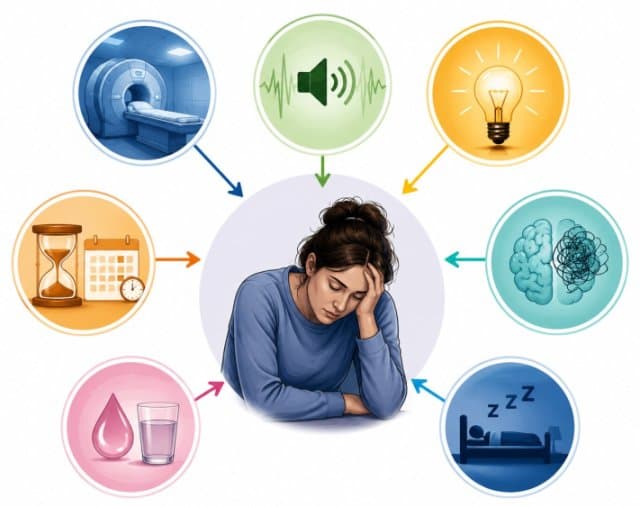
How an MRI Affects Your Body During the Scan
An MRI machine produces a magnetic field between 1.5 and 3 Tesla roughly 30,000 to 60,000 times stronger than Earth’s magnetic field.
This field causes hydrogen atoms in your body to temporarily align and then release energy as radio waves, which the scanner reads. This procedure is not neutral to the body, even if it is safe and non-ionizing.
Read Also: Light-headedness, dizziness and fatigue: Why does it happen?
Three things happen simultaneously during a scan that contribute to fatigue:
- Acoustic Stress: Gradient coils inside the machine switch rapidly, producing noise levels between 82 and 118 decibels (WHO, 2018). That is louder than a lawnmower running next to your head. Sustained exposure to high noise activates the auditory stress pathway and tires the nervous system.
- Forced Immobility: You must stay still for the entire scan, sometimes up to 90 minutes for full-body or spine protocols. Holding a fixed position under conscious effort uses more muscular and cognitive energy than relaxed movement, even though you feel like you are “just lying there.”
- Thermal effects: MRI gradients generate localized tissue heating. The FDA limits specific absorption rate (SAR) in clinical MRI to 4 W/kg for the whole body, but even within safe limits, mild tissue warming contributes to overall fatigue in sensitive individuals.
Psychological Stress’s Impact on Post-MRI Fatigue
Anxiety about the scan itself is one of the most consistent drivers of post-MRI fatigue. Research published in the Journal of Magnetic Resonance Imaging found that between 25 and 37 percent of patients report moderate to high anxiety before or during an MRI.
Anxiety activates the hypothalamic-pituitary-adrenal (HPA) axis, releasing cortisol and adrenaline. When the scan ends and those stress hormones clear, the drop in arousal feels like a crash.
Claustrophobia makes this worse. Even patients who do not consider themselves claustrophobic often experience an elevated heart rate and shallow breathing inside the bore of the machine. The brain reads confinement as a low-level threat and keeps the stress response active throughout the scan.
Why Lying Still is More Exhausting Than it Sounds?
Staying motionless for 30 to 90 minutes is harder on the body than most people expect. The effort comes from three sources:
- Active muscle tension: Your body braces against the urge to move. This sustained low-level contraction is tiring, especially in the neck, shoulders, and lower back.
- Controlled breathing: Technicians often ask you to hold your breath during certain sequences. Repeated breath-holds require conscious respiratory effort and add to the overall energy cost.
- Cognitive load: Focusing on staying still while ignoring loud noise and managing anxiety uses prefrontal cortex resources. Mental effort produces real fatigue, even when physical movement is zero.
See Also: Why Do I Feel So Tired Without Doing Anything?
Dehydration and Fasting as Hidden Contributors
Many patients arrive at their MRI appointment fasted or underprepared. Some imaging centers ask patients to fast for several hours before certain scans. Others simply forget to drink water because they were focused on the appointment.
Mild dehydration: even a 1 to 2 percent drop in body water reduces cognitive performance and increases reported fatigue. Pair that with low blood sugar from fasting and you have a physiological baseline that makes the scan’s other demands hit harder.
If you ate nothing and drank nothing before a 60-minute MRI, fatigue afterward is almost guaranteed by simple biochemistry, not by the machine.
Who Feels More Drained After an MRI?
Some groups are more likely to experience strong post-MRI fatigue:
- Patients with anxiety disorders or PTSD: The HPA axis is already primed; the scan pushes it further.
- People with chronic fatigue syndrome (CFS/ME): Any physical or psychological exertion can trigger post-exertional malaise.
- Older adults: Recovery from sensory overload takes longer as the autonomic nervous system becomes less responsive with age.
- Patients who had long scan protocols: A 90-minute spine-and-brain MRI stacks all the above stressors over a longer period than a 20-minute knee scan.
- First-time MRI patients: Unfamiliarity increases anxiety and startle responses, both of which increase energy expenditure.
How Long Post-MRI Fatigue Should Last
For most healthy adults, post-MRI fatigue without contrast clears within two to six hours. The body processes the residual stress hormones, blood sugar normalizes after eating, and the nervous system returns to baseline.
A full night of fatigue is within the normal range if the scan was long, the patient was anxious, or they arrived dehydrated.
Fatigue lasting more than 48 hours is outside normal range for a non-contrast scan. If yours persists beyond two days, or if you notice any of the following, call your doctor:
- New or worsening headache
- Numbness or tingling
- Dizziness that does not resolve
- Confusion or difficulty concentrating beyond 24 hours
These symptoms are not caused by the MRI itself but may reflect the underlying condition that prompted the scan.
What to Do Immediately After an MRI to Recover Faster?
Recovery is straightforward. The goal is to reverse the three main drivers: dehydration, low blood sugar, and stress hormone residue.
Eat and drink before you leave the facility. A meal or snack with carbohydrates and protein raises blood sugar and begins the recovery process within 20 minutes. Water or an electrolyte drink addresses any dehydration from fasting.
Give yourself 1-2 hours of low demand. Do not schedule a high-stakes meeting or a workout immediately after a long MRI. The body needs time to clear cortisol.
Sleep if you feel the pull. A short nap of 20-30 minutes is one of the fastest ways to process stress hormone residue and restore cognitive function.
Use earplugs next time. Many facilities offer them. Research in Radiography found that ear protection during MRI significantly reduces perceived stress and reported fatigue.