Red Light Therapy for Hair Growth: Does It Actually Deliver Results?
Red light therapy for hair growth uses low level red or near infrared light, typically in the 630 to 680 nanometer range, to stimulate hair follicles on the scalp.
It is also called low level laser therapy or low level light therapy, abbreviated LLLT. The general public most often encounters it through laser combs, laser caps, or LED helmets designed for home use.
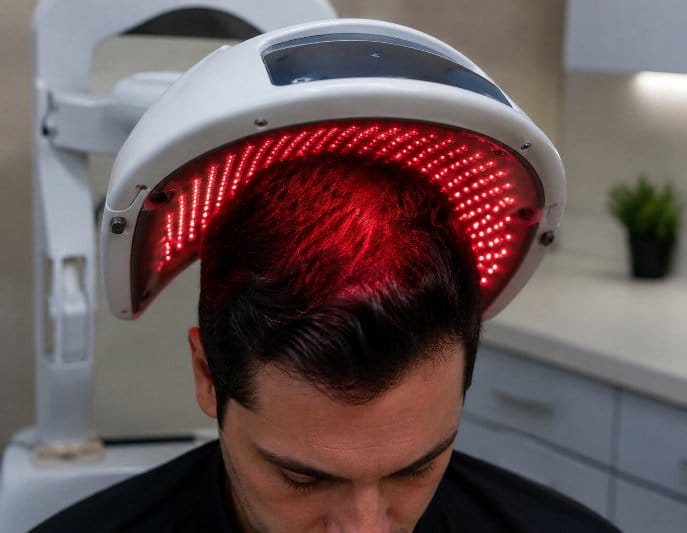
The light does not cut, burn, or heat tissue in the way surgical lasers do. Instead, it delivers a low dose of photons that scalp cells absorb, a process called photobiomodulation. The goal is to encourage follicles stuck in a resting phase to resume active growth.
Red light therapy is most studied for androgenetic alopecia, the genetic pattern hair loss that affects a large share of men and women over their lifetime. Smaller amounts of research also cover other forms of hair thinning, though evidence for those conditions is limited.
Table of Contents
How Red Light Therapy Works on the Scalp
Red and near infrared light penetrates the scalp and reaches the mitochondria inside hair follicle cells. Mitochondria are the structures that generate cellular energy.
Photobiomodulation research suggests the light boosts this energy output, which supports several downstream effects on hair growth.
- Increased blood flow to the scalp, which delivers more oxygen and nutrients to follicles.
- A shift of follicles from the resting phase, called telogen, into the active growth phase, called anagen.
- Thicker hair shafts on follicles that were producing thin, weak strands.
A 2026 twelve month prospective trial measured these effects directly. Hair density rose from 99.2 hairs per square centimeter at baseline to 124.2 hairs per square centimeter at week 48, a 25.6 percent increase, alongside a 15 percent gain in hair shaft thickness.
Read Also: Hair Scalp Massager for Hair Growth
What the Clinical Evidence Actually Shows
This is the part most marketing pages gloss over, so it deserves a direct answer. Yes, red light therapy has real trial support, but the size of the effect and the quality of individual studies vary.
A 2019 meta analysis pooled 11 double blind, sham controlled randomized trials and found a standardized mean difference of 1.316 in hair density favoring active treatment over sham devices, a result researchers described as significant.
A separate systematic review of FDA cleared home use devices found a similar effect size of 1.27, based on seven double blind randomized controlled trials.
A broader 2025 meta analysis covering studies through January 2024 confirmed the pattern. It reported a mean hair density increase with a standardized mean difference of 1.32 across treatment durations from 4 to 26 weeks, with slightly larger effects after 20 weeks of use compared to shorter courses.
Not every study agrees. One randomized controlled trial comparing red light therapy plus minoxidil against minoxidil alone found no statistically significant difference between the two groups after 16 weeks, with a P value of 0.45.
This kind of result is a reminder that adding red light therapy to an existing regimen does not always produce a measurable extra benefit, even though red light therapy alone consistently beats a sham device in most trials.
How Does it Compare to Minoxidil?
Some trials report that red light therapy performs comparably to topical 5 percent minoxidil for androgenetic alopecia over a matter of months.
One randomized controlled trial tracking hair density over six months found comparable percentage gains between the two approaches, with red light therapy avoiding the scalp irritation and systemic side effects that some minoxidil users experience.
Red light therapy and minoxidil work through different mechanisms, so combining them is common in clinical practice.
Several studies note that pairing red light therapy with minoxidil produced larger increases in hair diameter and density than either treatment alone.
Who is Most Likely to See Results
Red light therapy works on follicles that are still alive but miniaturized or inactive.
It is not a solution for completely bald areas with no follicular activity left, since there is nothing left to stimulate.
| Candidate Type | Likely Outcome |
|---|---|
| Early stage androgenetic alopecia, thinning but follicles present | Best documented results, often visible by 12 to 16 weeks |
| Moderate pattern hair loss | Meaningful density gains reported, may take longer to appear |
| Long standing bald patches with no follicles | Unlikely to regrow hair, since there is no follicle left to activate |
| Hair loss from autoimmune conditions, chemotherapy, or scarring alopecia | Evidence is smaller and more mixed, so expectations should be conservative |
Consistency matters as much as candidacy. Trials generally used devices three to seven times per week for 10 to 20 minutes per session over several months. Skipping sessions during the early growth window appears to reduce the benefit.
Safety and Side Effects of Red Light Therapy for Hair Growth
Red light therapy has a strong safety record in published research. The wavelengths used are non ionizing, meaning they do not damage DNA the way ultraviolet light can, and no study has linked them to skin cancer.
Reported side effects are generally mild and temporary.
- Mild scalp warmth or tingling during a session.
- Temporary redness that fades within hours.
- A short phase of increased shedding when starting treatment, which some clinicians describe as older, weaker hairs being replaced by new growth.
People with light sensitivity conditions such as lupus or porphyria, those on photosensitizing medications like certain antibiotics or retinoids, and people with active scalp infections should talk to a doctor before starting. Data on use during pregnancy is limited, so caution is reasonable there as well.
In the United States, red light therapy devices intended for hair growth are regulated by the FDA as Class II medical devices, cleared through the 510(k) pathway.
FDA clearance confirms a device meets safety standards. It does not mean the FDA has verified specific growth outcomes for that exact device, since clearance and full approval are different regulatory processes.
Conclusion
Red light therapy for hair growth has more clinical backing than most at home beauty devices, with multiple double blind, sham controlled trials and several meta analyses pointing in the same direction.
It is not a cure for all hair loss, and it will not bring back follicles that are already gone.
For people with early to moderate androgenetic alopecia who use a device consistently for several months, the published research supports real, measurable gains in hair density and thickness.