High Instep vs High Arch: Why Your Shoes May Not Fit
A High Instep and a High Arch are not the same thing. The instep is the top part of the foot, the area between the toes and the ankle. The arch is the curved area on the bottom of the foot that runs from the heel to the ball.
These are two separate parts of the foot, and each one can be high, low, or average on its own.
A person with a high instep has a foot that rises steeply from the toes toward the ankle when viewed from the side.
A person with a high arch has a foot that curves sharply upward on the sole, leaving a large gap between the ground and the middle of the foot.
Many people confuse these two terms because both affect shoe fit. But the cause, the symptoms, and the solutions are often different.
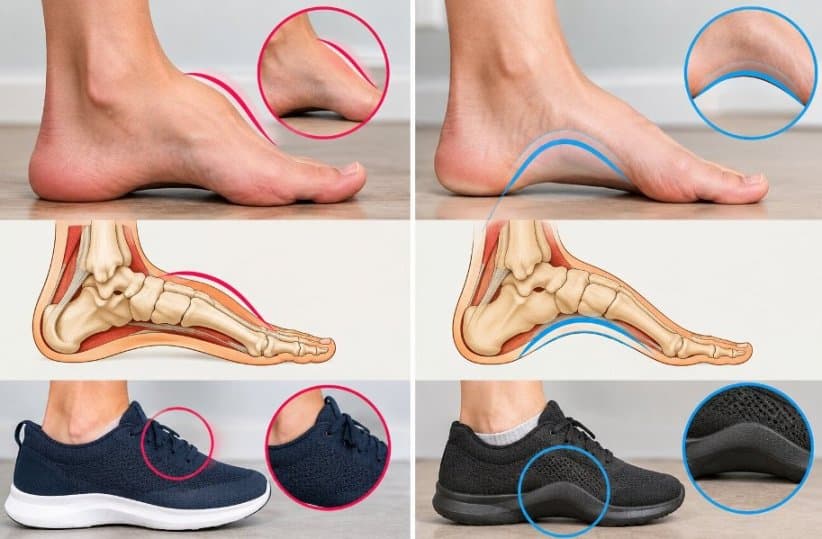
Table of Contents
What is a High Instep?
A high instep means the top surface of the foot is raised higher than average. When you look at the foot from the side, the top has a noticeable dome shape between the ankle and the toes.
People with a high instep often struggle to fit into shoes. Standard shoes feel tight across the top of the foot, and laces press down uncomfortably. This is a fit problem as much as a structural one.
Common signs of a high instep:
- Shoes feel tight across the top of the foot even when the length fits correctly.
- The shoe tongue bulges upward when laced.
- You often need a wide or extra-deep shoe to get comfortable fit.
- Blisters and pressure sores form on the top of the foot.
The instep height does not always relate to the height of the arch. A foot can have a high instep with a relatively normal arch curve underneath.
What is a High Arch?
A high arch, also called cavus foot, is a condition where the arch on the sole of the foot sits higher than normal.
It means the foot does not flatten much when you stand or walk. The medical term for this is pes cavus.
With a high arch, more weight falls on the heel and the ball of the foot. The middle section of the foot barely touches the ground.
This uneven weight distribution is the main source of problems connected to high arches.
Common signs of a high arch:
- The footprint shows only the heel and the front of the foot with little or no middle section.
- Calluses form quickly on the heel and ball of the foot.
- The foot feels stiff and does not flex much when walking.
- Ankle instability is common because the foot does not spread load evenly.
About 8 to 15% of people have pes cavus, and in many cases the cause is a neurological condition such as Charcot-Marie-Tooth disease.
Can You Have a High Instep and a High Arch at the Same Time?
Yes, you can have both. In fact, it is common. A foot with a high arch often also has a high instep because the entire foot structure is raised.
The arch pulls the foot upward from below, and this can create a higher dome on the top as well.
When both conditions are present, shoe fitting becomes more difficult. The foot needs depth from top to bottom, not just width.
Standard athletic shoes and casual shoes often fail to accommodate this combination.
If you have both a high instep and a high arch, look for shoes labeled as “extra depth” or “high volume” rather than just “wide.”
Wide shoes add room on the sides. Deep shoes add room from the sole to the top of the shoe, which is what you actually need.
How a High Instep Affects Shoe Fit and Daily Comfort?
A high instep makes shoe fitting harder than most people expect. The foot is taller from the sole to the top, so standard shoes press down on the top of the foot. This creates pressure on the tendons and blood vessels that run across the instep.
Signs that your shoes are not accommodating your high instep include numbness or tingling in the toes, redness across the top of the foot after wearing shoes, and pain that builds through the day.
Tips for finding shoes with a high instep:
- Look for shoes with a roomy toe box and a high vamp (the front upper section of the shoe).
- Choose lace-up shoes over slip-ons, as laces let you adjust tension across the top.
- Try extra-depth shoes designed for orthotic use, as these have more interior volume.
- Ask for a Brannock measurement that includes instep height, not just length and width.
How a High Arch Affects Walking, Balance, and Joint Health
A high arch changes how the entire body absorbs impact. A normal arch flattens slightly when the foot hits the ground.
This flattening acts as a shock absorber. A high arch does not flatten much, so the shock travels directly up through the heel, ankle, knee, and hip.
Over time, this leads to stress fractures, plantar fasciitis (pain along the bottom of the foot), and knee pain.
The ankle is also less stable because the foot cannot spread its base when landing.
Health problems linked to high arches:
- Plantar fasciitis, which is inflammation of the tissue running along the sole of the foot.
- Metatarsalgia, which is pain and inflammation in the ball of the foot.
- Ankle sprains, which happen more often because the foot rolls outward (supination).
- Claw toes or hammer toes caused by muscle imbalance in the foot.
The cushioned insoles with arch support as the first line of treatment for high arch-related pain in non-surgical cases.
Best Shoes for High Instep Feet
The best shoes for a high instep give the foot room to breathe without compressing the top. Look for these specific features.
What to look for in shoes for a high instep:
- A high vamp or deep upper that does not press down on the foot.
- Adjustable lacing systems that let you skip eyelets to reduce pressure at the instep.
- A wide or standard toe box with extra interior depth.
- Soft, flexible upper materials such as mesh or stretchy knit.
Best Shoes and Insoles for High Arch Feet
The best shoes for high arches provide cushioning under the heel and ball of the foot, plus lateral support to prevent ankle rolling.
Most standard flat insoles do not help because they do not fill the gap under the arch.
What to look for in shoes for high arches:
- A curved last (the shape of the shoe mold) that matches the arch curve.
- Extra cushioning in the heel and forefoot, not just the midfoot.
- A firm midsole that prevents excessive inward or outward rolling.
- A wide base for better stability when landing.
For insoles, semi-rigid orthotic insoles work better than soft foam for high arch feet. Soft foam compresses and offers no real support under the arch.
Semi-rigid insoles hold their shape and keep the arch from dropping under load.
Custom orthotics are also an option for severe cases. A podiatrist can prescribe these after a gait analysis.
How to Tell If You Have a High Instep, High Arch, or Both
The easiest test is the wet foot test. Wet the bottom of your foot and step onto a piece of brown paper or a flat surface where the print shows.
Reading your footprint:
- A normal arch leaves a print that shows the heel, the outer edge of the foot, the ball, and the toes, with a visible but narrow band connecting the heel and ball.
- A high arch leaves a print where little or no middle band appears. The heel and ball may look almost disconnected.
- A flat foot leaves a full print with no visible arch gap.
The wet foot test shows arch height only. It tells you nothing about instep height.
To check your instep, look at your foot from the side while sitting. If the top of the foot curves sharply upward and creates a tall dome between your ankle and toes, you likely have a high instep.
If both your footprint and your side view look elevated, you may have both conditions.
When to See a Podiatrist About High Instep or High Arch Pain
See a podiatrist if foot pain is affecting how you walk, interfering with daily activity, or not improving after switching footwear.
Both high instep and high arch problems can worsen over time without proper management.
Specific situations that need professional evaluation:
- Pain in the heel or ball of the foot that lasts more than two weeks.
- Frequent ankle sprains or a feeling of ankle instability.
- Numbness or tingling across the top of the foot that does not improve with looser lacing.
A podiatrist can perform a gait analysis, take X-rays to assess bone structure, and recommend custom orthotics or physical therapy if needed.