Exosome Therapy vs PRP for Hair Loss: Which Treatment Actually Works?
Hair loss clinics now offer two regenerative injections that promise thicker, denser hair without surgery: platelet rich plasma (PRP) and Exosome Therapy.
Both use your body’s own signaling molecules to wake up struggling hair follicles, and both are marketed with similar language. But they are not the same treatment, they are not backed by the same level of evidence, and they are not regulated the same way in the United States.
Here is what separates them, what the research actually shows, and how to think about the choice.
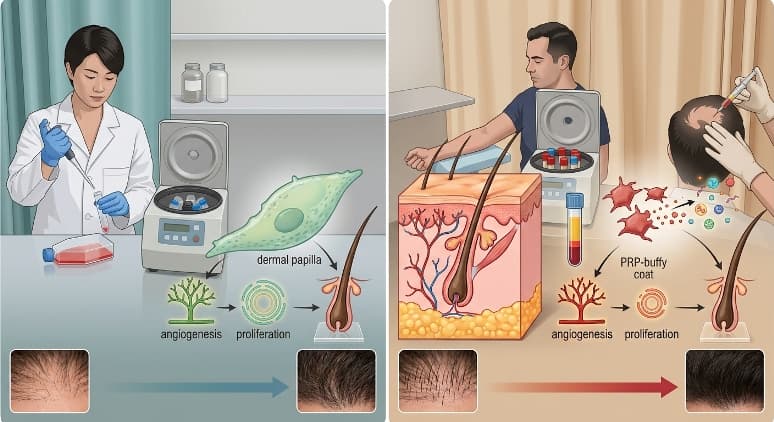
Table of Contents
What PRP and Exosome Therapy Actually Are
PRP is plasma drawn from your own blood and spun in a centrifuge to concentrate platelets, which release growth factors when activated.
Exosomes are tiny particles released by cells, including stem cells, that carry proteins and genetic material used for cell to cell communication.
In hair clinics, exosome products are typically derived from donor stem cells grown in a lab, not from the patient’s own body.
Both are injected into the scalp with the goal of stimulating dermal papilla cells, the structures at the base of each follicle that control hair growth.
The overlap in marketing language often makes them sound interchangeable. The underlying material, sourcing, and evidence base are not.
How PRP Works and What the Evidence Shows
PRP concentrates a patient’s own platelets, which release growth factors that appear to extend the growth phase of the hair cycle and support new blood vessel formation around follicles.
A 2025 review in Cureus analyzed 11 clinical trials from 2020 through 2024 and found that most demonstrated increased hair density and thickness in patients with androgenetic alopecia.
A separate meta analysis of ten randomized controlled trials covering 555 treatment units found a statistically significant increase in hair density after PRP compared to control groups.
The improvement was strongest in male only trial groups. A 2020 meta analysis reported density gains from roughly 142 hairs per square centimeter to 178 after treatment.
Results vary by preparation method, platelet concentration, and number of sessions, which is the main criticism researchers raise about PRP.
Combining PRP with microneedling has shown better outcomes than PRP alone in head to head trials, with one study reporting a hair count increase of 24.5 percent for the combination versus 17.9 percent for PRP alone.
PRP has also been studied specifically in women. A review of eight clinical studies covering 197 patients with female pattern hair loss reported high patient satisfaction and improved quality of life scores, particularly for women who had not responded to topical minoxidil.
How Exosome Therapy Works and What the Evidence Shows
Exosome Therapy uses lab cultured extracellular vesicles, usually derived from donor stem cells, to deliver growth signals directly to hair follicles without using the patient’s own blood.
The proposed mechanism includes activating hair follicle stem cells and promoting blood vessel growth around the follicle, based mostly on cell culture and animal research.
Human evidence remains thin. A 2023 systematic review in the Journal of Cosmetic Dermatology identified only 16 relevant studies, and just one was an actual clinical trial in humans, the rest were preclinical work in cells or animal models. The review’s authors concluded that current clinical evidence supporting exosome treatment is limited despite growing interest.
Smaller prospective studies have since emerged. A 2024 study of 30 male patients using foreskin derived stem cell exosomes reported decreased shedding and improved density at four and twelve weeks, though the study had no control group for comparison.
A 2025 prospective study in Aesthetic Plastic Surgery reported similar early gains. A 2022 retrospective review of 39 patients using adipose derived exosomes also reported improvement, but retrospective, uncontrolled studies cannot rule out placebo effect or natural fluctuation in shedding.
A separate 2025 randomized, placebo controlled pilot trial of only 20 men found measurable hair density improvements with an exosome formulation, one of the few studies in the field to include a true placebo arm. It is also one of the smallest trials in either category, which limits how much weight it can carry.
Regulatory Status: A Critical Difference
This is where the two treatments diverge sharply. PRP uses the patient’s own blood, processed with FDA cleared centrifuge devices, and is administered as part of standard medical practice.
It does not require premarket drug approval because it is not a manufactured biological product.
Exosome products are a different legal category. The FDA classifies therapeutic exosomes as drugs and biological products that require premarket review, and it has stated plainly that no exosome product currently holds that approval for any condition.
Starting in 2019, the agency issued a public safety alert after patients in Nebraska experienced serious adverse events from unapproved exosome injections.
Enforcement has continued since: the FDA sent warning letters to exosome sellers including Kimera Labs in 2023 and Chara Biologics in 2025, and by 2026 legal analysts tracking the agency’s actions counted enforcement letters against at least six additional companies.
This does not mean exosome therapy cannot work. It means that any clinic offering it in the United States is doing so outside of FDA approval, and the manufacturing quality, sterility, and exosome content of these products can vary between suppliers with little independent verification.
Which One Has Stronger Clinical Support
PRP wins this comparison on evidence alone. It has more than a decade of published trials, several meta analyses, and consistent results across androgenetic alopecia in both men and women.
Exosome therapy is still in an early research phase, closer to where PRP stood 10 to 15 years ago. Promising early data exists, but it comes largely from small, uncontrolled, or industry connected studies.
That gap matters most for anyone weighing cost against likely outcome. Paying a premium for a less studied, unapproved treatment is a different decision than paying for one with an established track record, even an imperfect one.
Conclusion
PRP and exosome therapy target the same problem through related biology, but they sit in very different places on the evidence and regulatory spectrum.
PRP has years of clinical data, a well understood safety profile, and FDA cleared preparation equipment, even though results still vary by protocol and patient.
Exosome therapy has an interesting theoretical basis and a handful of encouraging small studies, but it lacks FDA approval, standardized manufacturing, and the kind of controlled trials that would make its results reliable.
Anyone considering either option should start with a dermatologist who can confirm the type and cause of hair loss, since neither treatment works as well when the underlying driver goes unaddressed.