What Causes Hip Pain When Bending Over?
If you catch yourself bracing for pain every time you drop something on the floor or put on your shoes, your hip is sending you a clear signal. Bending forward forces your thigh bone and hip socket closer together, putting maximum pressure on the front of the joint.
When something in that small space isn’t moving smoothly, you get that sudden, sharp pinch.
While you figure out what is causing it, small daily changes can bring quick relief. Keep your hips higher than your knees when sitting, squat down using your legs instead of bending over, and lay off deep squats or heavy hip flexing while the area calms down.
Here is a simple breakdown of what might be happening inside the joint and how to handle it.
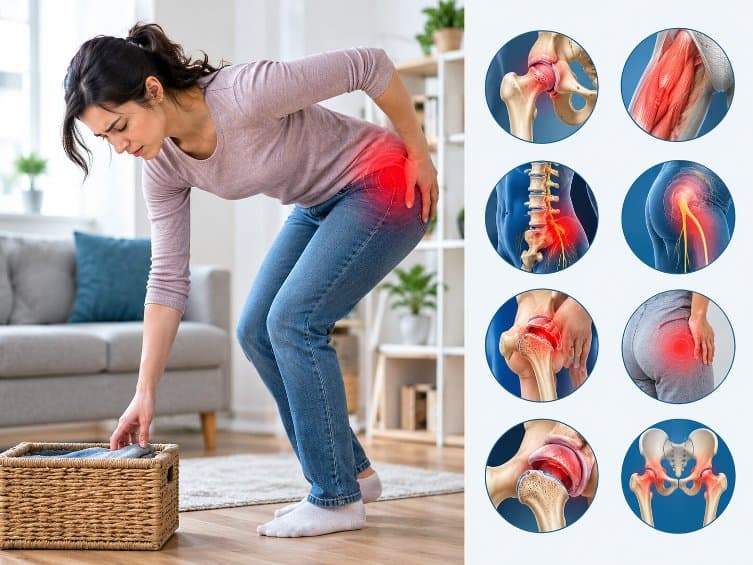
Table of Contents
Why Does Bending Over Make the Hip Hurt?
Bending over hurts the hip because the movement is hip flexion: the thigh bone rotates forward and the front of the joint gets tighter.
Every structure in that space, including bone, cartilage, muscle, and tendon, takes more load. A small problem in any one of them shows up quickly.
Think of a door hinge. It swings freely until a bent pin or a bit of grit gets inside. Then the door sticks at one particular angle, and that angle is where you feel it.
The hip works the same way. The ball (the top of the thigh bone) sits in a cup (the socket, called the acetabulum), and a rim of cartilage called the labrum lines the cup.
When you fold forward, the ball and cup get closer together at the front. If the shape is slightly off, or the labrum is frayed, this is the position that exposes it.
Explore This: Why Does My Elbow Hurt When I Extend It?
Femoroacetabular Impingement: When the Hip Bones Pinch
Femoroacetabular impingement (FAI) happens when the ball and socket do not fit together smoothly, so the bones catch or rub during movement.
The pain is typically in the groin or the front of the thigh and gets worse with bending at the hip or waist, for example when tying shoes.
FAI has two main shapes. In cam impingement, the ball is more oval than round. In pincer impingement, the socket covers too much of the ball. Some people have both.
Over time, this repeated contact can tear the labrum and wear down cartilage, which raises the risk of arthritis. FAI is more common in active people, especially those in sports with lots of twisting and squatting.
Researchers reviewing the literature estimated that FAI should be considered in 47 to 74% of patients who have hip pain but no sign of arthritis. It is a common answer to this exact question.
Hip Labral Tear: A Catch, Click, or Deep Ache
A hip labral tear is damage to the ring of cartilage around the socket. The typical symptoms are pain in the hip or groin, a locking, clicking, or catching feeling, and stiffness or a reduced range of motion.
Some tears cause no symptoms at all. When they do hurt, the pain often gets worse after long periods of sitting, standing, or walking, and a forward bend combined with an inward twist of the knee tends to bring it on.
Labral tears and FAI often go together. A tear can also make arthritis in that joint more likely later. Because the pain overlaps with a muscle strain, tears are sometimes misdiagnosed as a hip flexor problem at first.
Hip Flexor Strain: A Muscle Problem, Not a Joint Problem
A hip flexor strain is a stretch or tear in the muscles at the front of the hip that lift your knee and let you bend at the waist.
It usually starts with a clear event, such as a sudden change of direction while running, and hurts when you lift the knee or bend forward.
Strains are graded by severity. Grade 1 means a few fibers are damaged and the hip works normally. Grade 2 means a moderate tear with some loss of function. Grade 3 is a full rupture where walking without a limp is usually impossible.
Mild strains often settle with rest and gentle stretching. If symptoms last longer than 10 days, book an appointment.
Hip Osteoarthritis: Gradual Stiffness That Builds Over Time
Hip osteoarthritis is the gradual wearing down of the cartilage that cushions the joint. It causes tenderness, stiffness, and a loss of flexibility, and bending forward is one of the first movements that feels tight.
The pain tends to arrive slowly rather than after a single event. Mornings can feel stiff, and pain often flares after a busy day.
It is possible to have arthritis and impingement together, which is why one diagnosis does not rule out another.
Bursitis and Pain That Starts Outside the Hip
Bursitis is irritation of a fluid filled cushion (a bursa) near the hip. It typically causes pain with exercise or direct pressure, and the area over the bony point on the outside of the hip is tender to touch.
Not every hip pain starts in the hip. A sacroiliac (SI) joint problem, where the lower spine meets the pelvis, can also cause pain in this region, and doctors use specific movement tests to separate it from a true hip joint problem.
If your pain sits toward the outside or the back rather than the groin, or it travels down the leg, mention that to your doctor. It changes where they look.
How to Tell the Causes Apart
The location and the feel of the pain give useful clues, though only an examination can confirm the cause. This table summarizes the usual patterns.
| Likely cause | Where it hurts | What it feels like | Other signs |
|---|---|---|---|
| Femoroacetabular impingement | Groin or front of the hip | Sharp pinch at the end of a bend | Stiffness, worse with squatting |
| Labral tear | Groin or front of the hip | Deep ache | Clicking, catching, or locking |
| Hip flexor strain | Front of the hip or upper thigh | Pull when lifting the knee | Clear start after activity, possible bruising |
| Hip osteoarthritis | Groin, sometimes the thigh | Slow, aching stiffness | Reduced movement, morning stiffness |
| Bursitis | Outer side of the hip | Tenderness to touch | Pain when lying on that side |
What You Can Do at Home While the Pain Settles
For mild pain without an injury, the goal is to stop poking the sore spot while the area calms down. These changes are safe for most people.
- Hinge at the hips and keep your back straight when you pick things up, instead of folding deep at the waist.
- Bend your knees and keep the load close to your body, so the hip does not have to close fully.
- Sit on a slightly raised seat, so your hips stay open wider than your knees.
- Pause activities that bring on sharp pain, such as deep squats, for a couple of weeks.
- Use over the counter pain relievers and ice for short term relief if they are safe for you.
If the pain lingers, physical therapy is a sensible first step. One orthopedic group suggests seeing a hip specialist if there has been no improvement after 4 to 6 weeks of therapy.
When Hip Pain Needs a Doctor
Book a visit if the pain has not improved after 6 weeks or if it is getting worse. A doctor will examine the hip, ask about your activity history, and may order X rays.
An MRI with contrast dye, called an MR arthrogram, is the test used to confirm a labral tear.
Get seen sooner if any of these apply:
- You cannot put weight on the leg.
- There is significant swelling, bruising, or weakness.
- The pain follows a fall or direct impact.
- Your range of motion is dropping over time.
Conclusion
Tying your shoes or reaching for the floor shouldn’t come with a sharp reminder that something is off. Whether it’s a minor muscle strain or joint impingement, early intervention is the secret to preventing long-term damage and staying active.
Listen to what your hip is telling you today. Adjust your movements to give the joint room to rest, track your symptoms, and reach out to a healthcare professional if things don’t improve after a few weeks.
The right treatment path can quickly restore your mobility and get you back to living pain free.