How to Treat Blocked Ears in Pregnancy Safely and Naturally
Table of Contents
Key Takeaways
- Blocked ears in pregnancy are a hormonal side effect caused by Eustachian tube swelling, not infection.
- The Valsalva maneuver, saline nasal spray, steam inhalation, and adequate hydration cover most cases without medication.
- Any blocked ear accompanied by pain, discharge, hearing loss, or dizziness needs same-day medical assessment.
- Symptoms in the vast majority of cases clear after delivery once progesterone returns to baseline.
What Causes Blocked Ears During Pregnancy
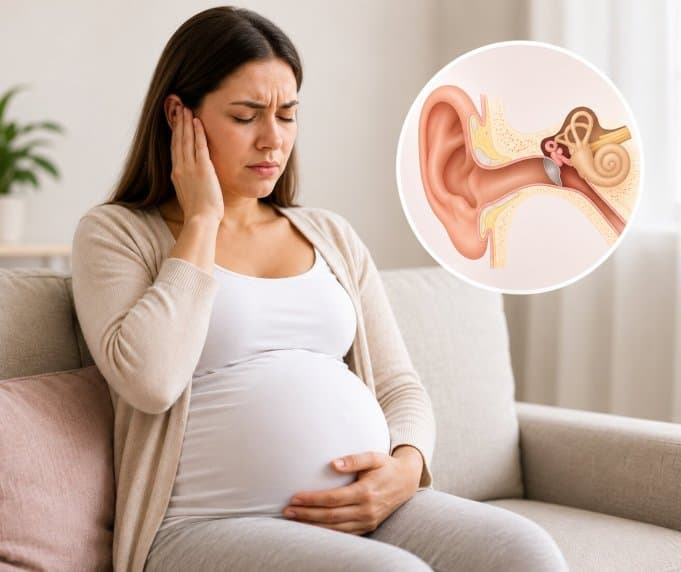
Blocked ears in pregnancy are a direct result of elevated progesterone. From the first trimester onward, progesterone causes the mucous membranes lining the Eustachian tube to swell and retain fluid.
The Eustachian tube, also called the auditory tube, is a narrow canal connecting the middle ear to the back of the throat.
Its function is to equalize air pressure in the ear and drain accumulated fluid. When hormonal swelling prevents it from opening and closing properly, the result is the muffled, full, or pressurized sensation pregnant women describe as blocked ears.
This is the same mechanism behind pregnancy rhinitis, a condition where nasal congestion develops from hormonal changes alone, with no allergy or infection involved.
Around 20% of pregnant women develop pregnancy rhinitis. If your blocked ears always come with a stuffy nose and neither started before pregnancy, these two conditions share the same cause.
Safe At-Home Treatments for Blocked Ears During Pregnancy
The following methods are safe at all stages of pregnancy and do not require medication. Consistency matters more than intensity: doing these twice a day produces better results than doing them once when the symptom peaks.
The Valsalva Maneuver: How to Safely Pop a Blocked Ear
The Valsalva maneuver directly opens the Eustachian tube by equalizing pressure. To perform it correctly:
- Take a gentle breath in.
- Close your mouth and pinch both nostrils shut.
- Slowly and gently attempt to exhale through the nose while keeping it pinched.
- You should feel a slight pop or pressure shift in the ear.
The maneuver must be performed gently. Forcing it hard pushes bacteria from the throat into the middle ear and can trigger an infection. Repeat once or twice per session, not more.
Saline Nasal Spray for Eustachian Tube Relief
A saline nasal spray is one of the most consistently effective tools for pregnancy-related ear blockage. It contains no active drug ingredient, making it safe throughout all three trimesters.
Spraying each nostril two to three times a day clears mucus from the nasal passages and reduces the secondary pressure on the Eustachian tube over several days of regular use.
Results from a single application are modest. The benefit builds with daily use over a week or more.
Steam Inhalation to Reduce Nasal Congestion
Steam inhalation reduces congestion in the upper nasal passages, which lowers the pressure load on the Eustachian tube. Fill a bowl with hot water, lean over it with a towel draped over your head, and inhale through the nose for 5 to 10 minutes.
Plain steam is effective on its own. If you choose to add eucalyptus oil, one to two drops is sufficient.
Check with your midwife before using any essential oil in the first trimester, as evidence on safety during early pregnancy is limited.
Warm Compress Over the Affected Ear
A warm flannel or heat pad placed over the blocked ear for 10 to 15 minutes relaxes surrounding tissue and can encourage the Eustachian tube to open. It works best as a supplement to steam inhalation, not as a standalone remedy.
Hydration
Dehydration thickens mucus secretions and makes Eustachian tube drainage harder. Drinking around 2.5 liters of water per day keeps mucus thinner and easier to clear.
For women managing nausea or morning sickness, small frequent sips throughout the day are more practical than large amounts at once.
Jaw Movement and Gravity
Swallowing, yawning, and chewing gum activate the muscles that open the Eustachian tube. Many women find a blocked ear that develops overnight clears on its own within 30 minutes of being upright.
In the third trimester, sleeping on your left side rather than your back reduces fluid pooling, which can ease morning ear pressure.
Treatments to Avoid Without Medical Guidance
Several standard ear or congestion remedies carry safety concerns during pregnancy. Do not use the following without speaking to your GP or obstetrician first.
| Treatment | Reason to Avoid |
|---|---|
| Oral decongestants (e.g. pseudoephedrine) | Linked to congenital defects when used in the first trimester |
| Antihistamine nasal sprays | Safety classification varies by product; not universally safe in pregnancy |
| Ear candling | No clinical evidence of effectiveness; carries burn and perforation risk |
| Over-the-counter ear drops | Many contain ingredients not evaluated for pregnancy safety |
| Cotton buds in the ear canal | Push wax deeper, worsen impaction, and can damage the canal lining |
If you used any of these before knowing you were pregnant, a single exposure is unlikely to cause harm. Mention it at your next antenatal appointment.
When to See a Doctor
Routine pregnancy-related ear blockage resolves without medical treatment. See a doctor the same day if you experience any of the following alongside the blocked feeling:
- Pain inside the ear
- Discharge or fluid from the ear canal
- Hearing loss that does not clear
- Dizziness or balance problems
- Tinnitus (ringing or buzzing) that starts suddenly
- Fever above 38°C
These symptoms can indicate otitis media (middle ear infection), an inner ear condition, or, in rare cases, otosclerosis.
Ear infections during pregnancy are treated with antibiotics that are confirmed safe for the baby, so there is no clinical reason to delay.
One specific combination requires urgent attention: tinnitus alongside headache, visual disturbance, or facial and hand swelling can be a sign of preeclampsia.
Contact your maternity unit immediately if those symptoms appear together. A blocked or muffled ear on its own is not associated with preeclampsia.
How Blocked Ears Change Across Each Trimester
Blocked ears do not present identically throughout pregnancy. Selecting the most appropriate course of action is much easier when you know what causes the symptom at each step.
First trimester: Progesterone rises rapidly, so Eustachian tube swelling is most unpredictable. Symptoms tend to come and go without a clear pattern.
Second trimester: Blood volume increases by approximately 50% by week 20. This rise in total body fluid makes nasal congestion and ear pressure more persistent, even after progesterone levels stabilize.
Third trimester: Lying flat on your back reduces venous return to the heart and increases fluid pooling in soft tissue. Sleeping on your left side measurably reduces this effect and often eases morning ear pressure.
Common Mistakes That Make the Symptom Worse
Treating it like a wax problem. Pregnancy ear blockage is pressure-related, not wax-related. Cotton buds and ear drops designed to soften wax do not address the cause and can cause secondary problems.
Using a pharmacy decongestant without checking pregnancy safety. Pharmacists do not always ask whether you are pregnant before recommending a decongestant. Always disclose your pregnancy at the counter before accepting any medication.
Doing steam inhalation once and stopping. Steam inhalation is most effective as a twice-daily habit over several days. One session during a symptom peak produces little lasting relief.
Waiting too long when pain develops. A blocked ear without pain can safely be managed at home. Once pain enters the picture, that changes the clinical situation and warrants a GP call the same day.
Conclusion
Start with the basics: the Valsalva maneuver, a saline nasal spray twice a day, and steam inhalation. These three methods address the underlying cause directly and are safe at every stage of pregnancy.
If symptoms persist beyond two weeks of consistent home treatment, or if any pain, hearing change, or dizziness develops at any point, that is the signal to call your GP or midwife.
Pregnancy ear blockage almost always resolves after delivery, but you should not have to simply wait it out if the symptom is affecting your sleep, concentration, or daily comfort. Relief is available, and asking for help is the right call.